
Food
How to Roast a Perfect Turkey: Crisp Skin, Juicy Meat and Good Gravy
Choose the right bird, plan the thaw, decide whether to brine, and roast with confidence—plus foil tenting, resting and gravy from the drippings.
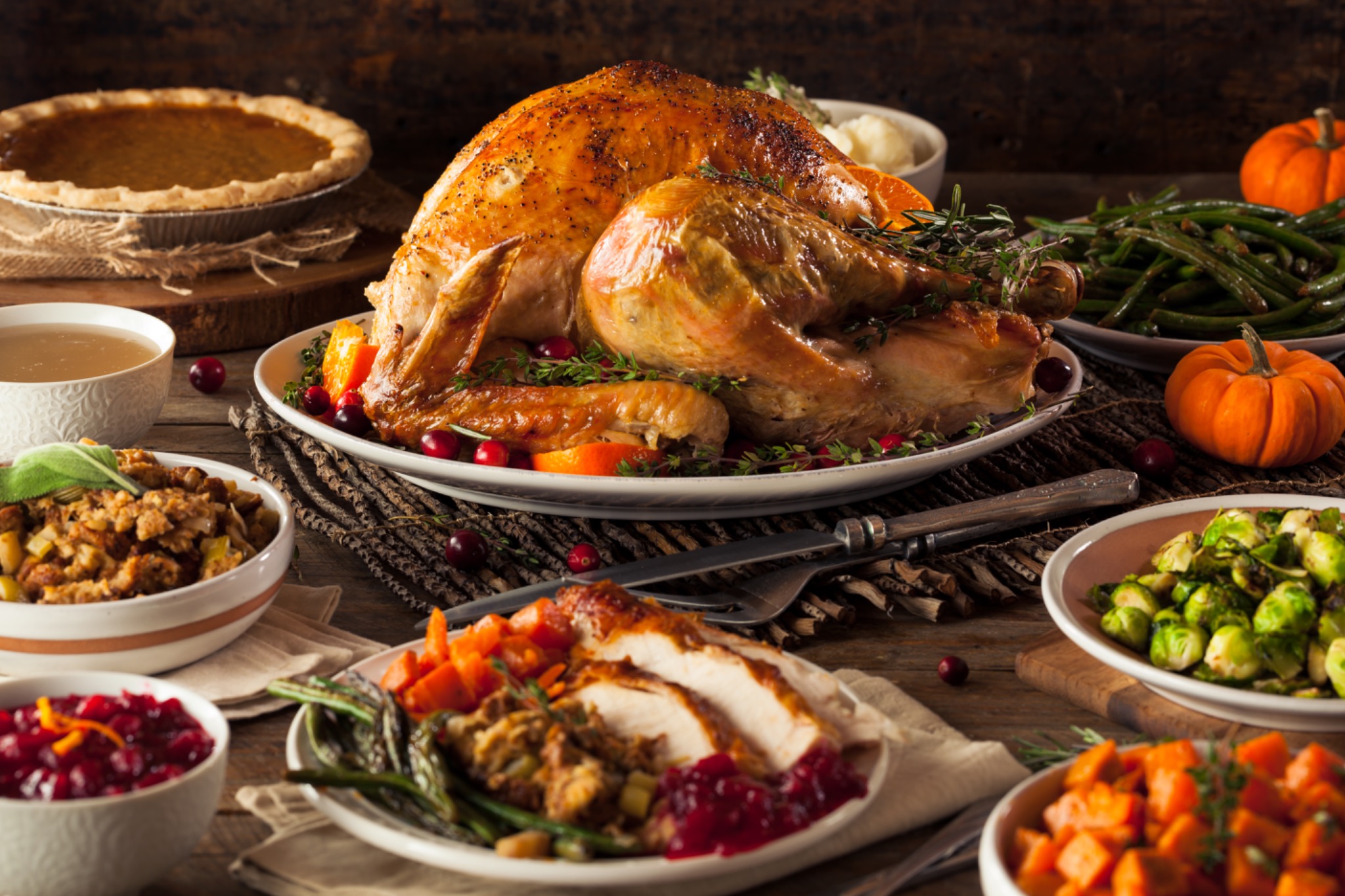
A good Thanksgiving turkey starts at the shopping counter. The bird's size, whether it already contains salt, and the space in your refrigerator all affect what happens on roasting day. Get those decisions settled and the cooking becomes a manageable sequence: dry the skin, season thoughtfully, roast until properly cooked, and leave time to rest before carving.
This guide is built around a fully thawed, unstuffed whole turkey roasted in an ordinary oven. Use an instant-read thermometer to judge doneness. The clock helps you plan dinner; the temperature tells you when the turkey is ready.
Choose a bird that suits the table
Allow roughly 1 pound of whole turkey per person as a starting point, or about 1½ pounds when generous leftovers are part of the plan. Appetites and side dishes matter. For a large gathering, two manageable birds can be easier to cook evenly than one enormous turkey—provided your oven has room for the pans with air circulating around them.
Fresh and frozen are storage descriptions. A properly handled frozen turkey is a perfectly sensible choice, particularly when you want to buy ahead. A fresh bird saves thawing time but needs a well-timed pickup and refrigerator space. Plan to cook fresh raw turkey within 1–2 refrigerated days, or freeze it.
What the different turkey labels mean for dinner
Conventional broad-breasted turkeys provide the familiar generous breast and mild flavor many families expect. A local farm may raise the same kind of bird: buying locally does not automatically mean buying a heritage turkey.
Heritage varieties, such as Bourbon Red or Narragansett, are a different proposition. They tend to have proportionally smaller breasts, more pronounced flavor and a different texture. Ask the grower for advice about the particular bird rather than assuming its cooking time will match a supermarket turkey of the same weight.
Organic and pasture-raised descriptions concern production practices; they do not tell you whether salt has been added. Kosher turkeys have undergone a salting process. Enhanced, self-basting and pre-brined birds contain an added solution. For seasoning decisions, the ingredients panel is more useful than a pastoral picture on the wrapper.
Find a turkey from a local source
Start with a farmers market, an independent butcher or a poultry farm that takes holiday reservations. Ask about available weight ranges, whether the bird will be fresh or frozen, whether it contains an added solution, the full price per pound, and the pickup arrangements. If you want to spatchcock it or make a roulade, ask whether the butcher can do the preparation for you.
For Rochester-area readers, Ridgecrest Turkey Farm in Clarkson and Stonecrop Farm in Rush are useful starting points. As checked November 16, Stonecrop says its 2026 deposits are closed and directs remaining inquiries to a waitlist. Contact the farm before making a trip; a listing is not a promise of availability.
Coordinate pickup with the short raw-turkey refrigerator-storage window. If collection is substantially earlier than cooking day, discuss a frozen bird or a freezing-and-thawing plan. Carry it home cold and keep it at 40°F or below.
Give the turkey enough time to defrost
Leave the wrapped bird on a rimmed tray in a refrigerator at 40°F or below, where drips cannot reach ready-to-eat food. Allow approximately 24 hours for each 4–5 pounds. The infographic gives the practical size ranges. Once refrigerator-thawed, cook within another 1–2 days; include any refrigerated brining in that schedule.
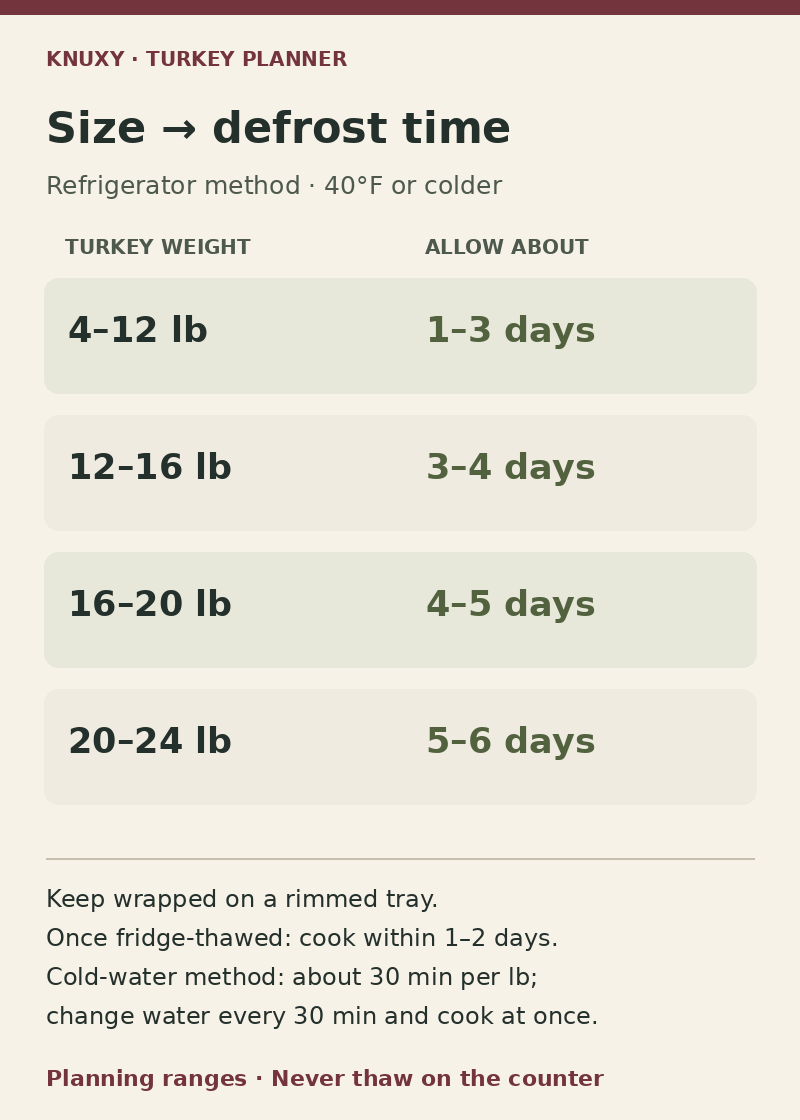
If you are short on time, keep the turkey in a leakproof wrapper and submerge it in cold tap water, changing the water every 30 minutes. Allow about 30 minutes per pound and cook immediately after thawing this way. Do not use the counter, hot water or an overnight sink soak. Special cook-from-frozen products have their own directions; this guide's thawing and roasting timetable does not apply to them.
Should you brine?
Brining seasons the meat and can help it retain moisture. It is most useful when the starting bird is plain and unseasoned. A dry brine uses measured salt on the surface; a wet brine immerses the bird in a salt solution and demands a large food-safe container plus enough refrigerator space to keep everything cold.
For an unseasoned bird, a dry brine is a convenient choice. Follow a weight-based brining recipe, weigh the salt, and keep the bird refrigerated throughout. Different kosher-salt brands have very different weights per spoonful. Set the bird on a tray, keep it below other food, and count that time within its safe refrigerated storage period.
For a bird labeled pre-brined, enhanced, self-basting or kosher, our default is to skip another full salt treatment. Use unsalted butter, herbs, citrus zest and pepper for added flavor. Salt cannot rescue overcooked breast meat, and more salt is not automatically more insurance.
Butterball birds and the gravy question
Butterball's standard fresh whole turkey lists up to 4% of a solution containing water, salt and spices; its standard frozen whole turkey lists up to 8% of a solution containing water, salt, spices and natural flavor. Read your own wrapper, because other products and formulations can differ.
You can make gravy from a Butterball bird's drippings. The useful caution is salt concentration, especially if you add another brine, use salted butter or roast over salted stock. Begin the gravy with unsalted stock, bring the cooking juices to a boil before tasting, and add the drippings gradually. If they are too salty to carry the gravy, make an unsalted stock-and-butter base and use a small amount for turkey flavor. Leave the final seasoning until the end.
Our pan-dripping gravy guide explains how to separate fat from juices, build a smooth roux and adjust salty drippings.
Set up the roasting pan
A sturdy pan with secure handles and a removable rack makes it easier to lift the bird and collect the cooking juices. Check the turkey's footprint, your oven dimensions and the clearance around the handles before buying. Leave room for hot air to move around the pan.
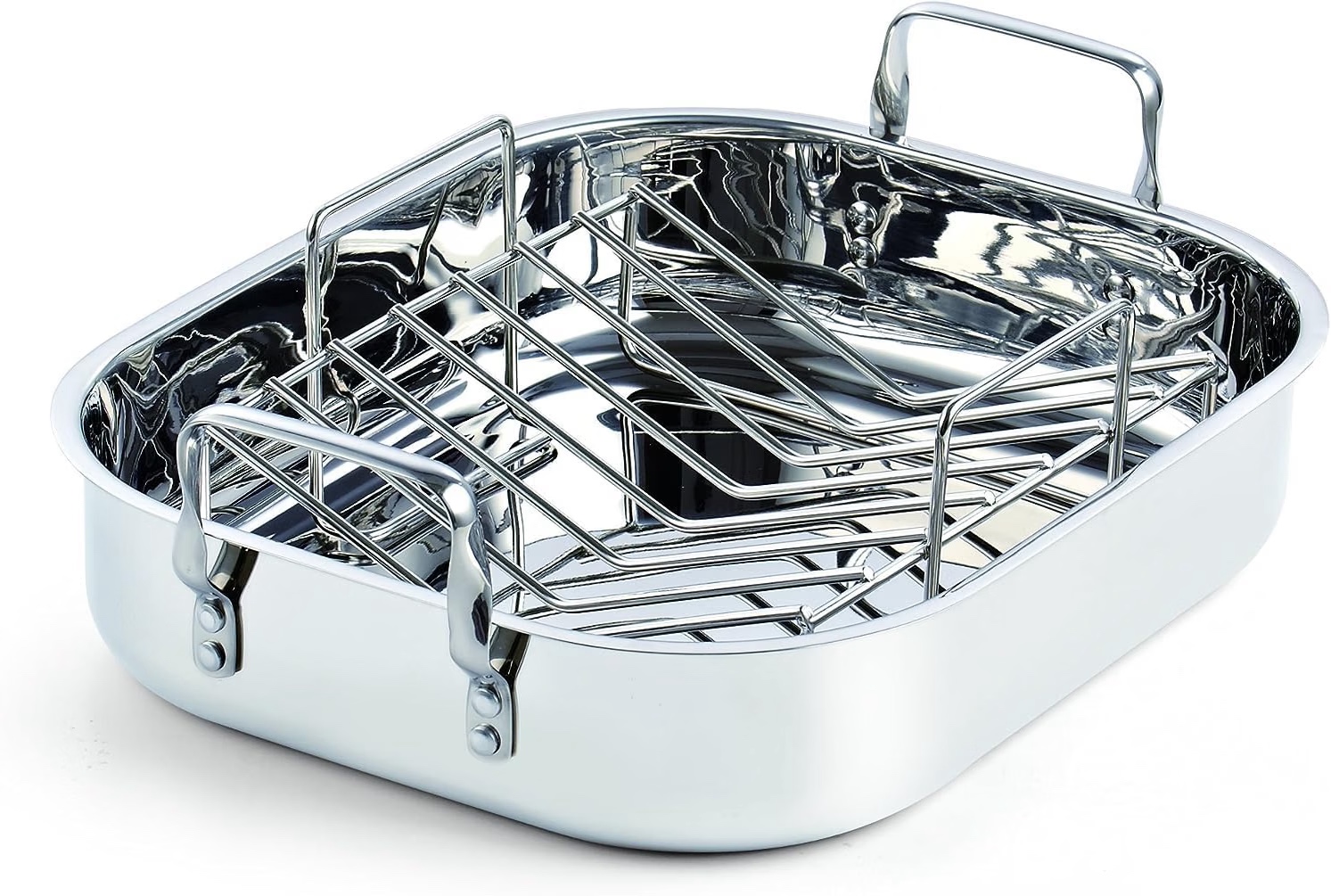
Neal's roasting-pan pick is the stainless steel pan with rack shown above. The rack lifts the bird above the juices, and the pan collects the drippings for gravy. Check the linked listing for its exact dimensions, capacity and care instructions. Confirm stovetop compatibility with the manufacturer before placing any roasting pan over a burner.
Advertisement · affiliate link. As an Amazon Associate we earn from qualifying purchases.
View the roasting pan on Amazon
Have an instant-read thermometer, heavy-duty foil, a carving board with a juice groove, a heatproof measuring jug or fat separator, and a saucepan ready as well. Keep raw-poultry utensils separate from the board and utensils you will use for the cooked bird.
Roast the whole bird
1. Prepare the turkey
Heat the oven to 325°F and position a rack so the bird will sit near the center. Remove the neck and giblet packets from both cavities. Do not wash the turkey: pat it dry with paper towels, then clean the work surface and wash your hands. A dry surface helps the skin brown.
Place the turkey breast-side up on the roasting rack. Tuck the wing tips under the shoulders. Leave the cavity unstuffed; bake stuffing separately so it does not complicate the meat's cooking time. A little onion or a few herb sprigs may scent the cavity, but do not pack it tightly.
2. Season and start roasting
Rub the skin with a thin coating of oil or softened unsalted butter. If you like, gently loosen the breast skin and spread a little herb butter directly over the meat, taking care not to tear the skin. For a bird already treated with salt, begin without adding more. For a plain bird, season according to its brining or seasoning plan.
Roast with the breast exposed at first so it can take on color. Avoid opening the oven repeatedly to baste: brushing the surface does not establish that the interior is cooked, and each interruption makes timing less predictable. If the pan juices begin scorching, add a small splash of hot water to the pan, away from the skin.
3. Use the timetable to plan, then use the thermometer
For fully thawed, unstuffed whole birds at 325°F, allow approximately 2¾–3 hours for 8–12 pounds; 3–3¾ hours for 12–14 pounds; 3¾–4¼ hours for 14–18 pounds; 4¼–4½ hours for 18–20 pounds; and 4½–5 hours for 20–24 pounds. Start checking before the end of the range. Pan shape, oven performance and the bird itself affect the result.
Check the thickest part of the breast and the innermost thigh and wing, avoiding bone. Each location must reach at least 165°F before the bird comes out. Dark meat can be cooked higher for texture, but do not keep roasting an already-done breast simply to satisfy an estimated time. Follow any higher product-specific endpoint on the wrapper. Skin color, clear juices and a pop-up timer are not substitutes for checking several places.
How to tent a turkey with foil
Tenting is a way to shield a surface that has browned enough. When the breast reaches the color you want but the turkey still needs cooking, fold a large piece of heavy-duty foil into a peaked roof. Set it loosely over the breast, leaving air space above the skin and the ends open. Use oven mitts, keep foil clear of heating elements, and return the bird to the oven.
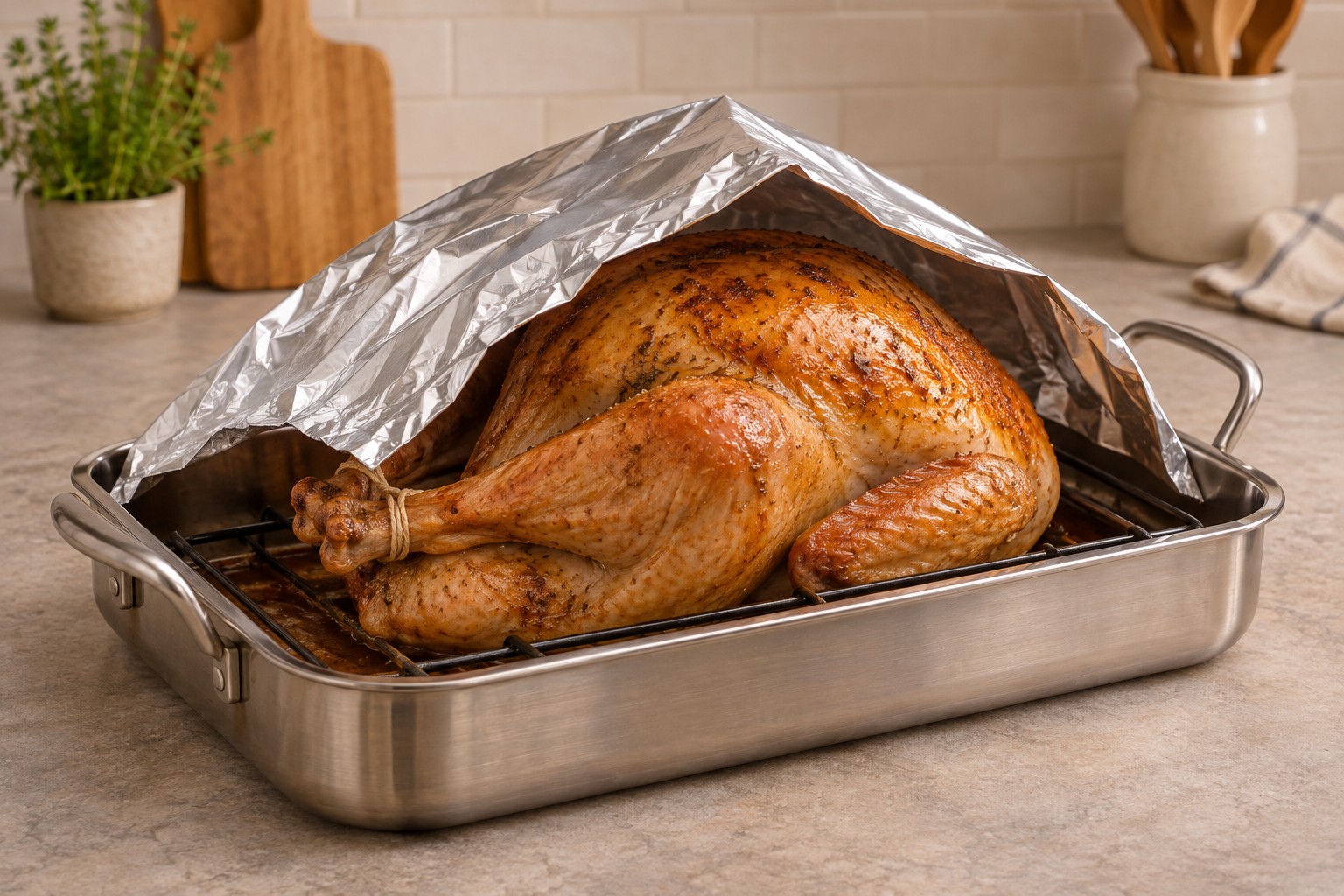
Do not seal the entire pan into a foil parcel. A loose shield protects the breast while leaving room for moisture to escape. The foil changes browning; it does not tell you when the meat is done. Continue checking the internal temperature.
Rest before carving
Move the fully cooked bird to a clean carving board and allow about 20–30 minutes before carving. The pause lets the meat settle and gives you time to finish gravy and heat the sides. Use a loose foil tent if needed; tight wrapping traps steam and softens the skin. Resting on the board also frees the roasting pan for collecting its juices.
Resting is part of the cooking schedule, not an unlimited warm hold. Refrigerate leftovers within two hours of cooking, including carving and serving time; use a one-hour limit when the surroundings are above 90°F.
Remove the legs and thighs, separate the joints, then lift each breast lobe from the bone and slice it across the grain on the board. Arrange on a warm platter and collect the board juices for the gravy. You can serve a beautiful turkey without trying to carve neat breast slices while they are still attached to a slippery carcass.
Choose another route to a great turkey dinner
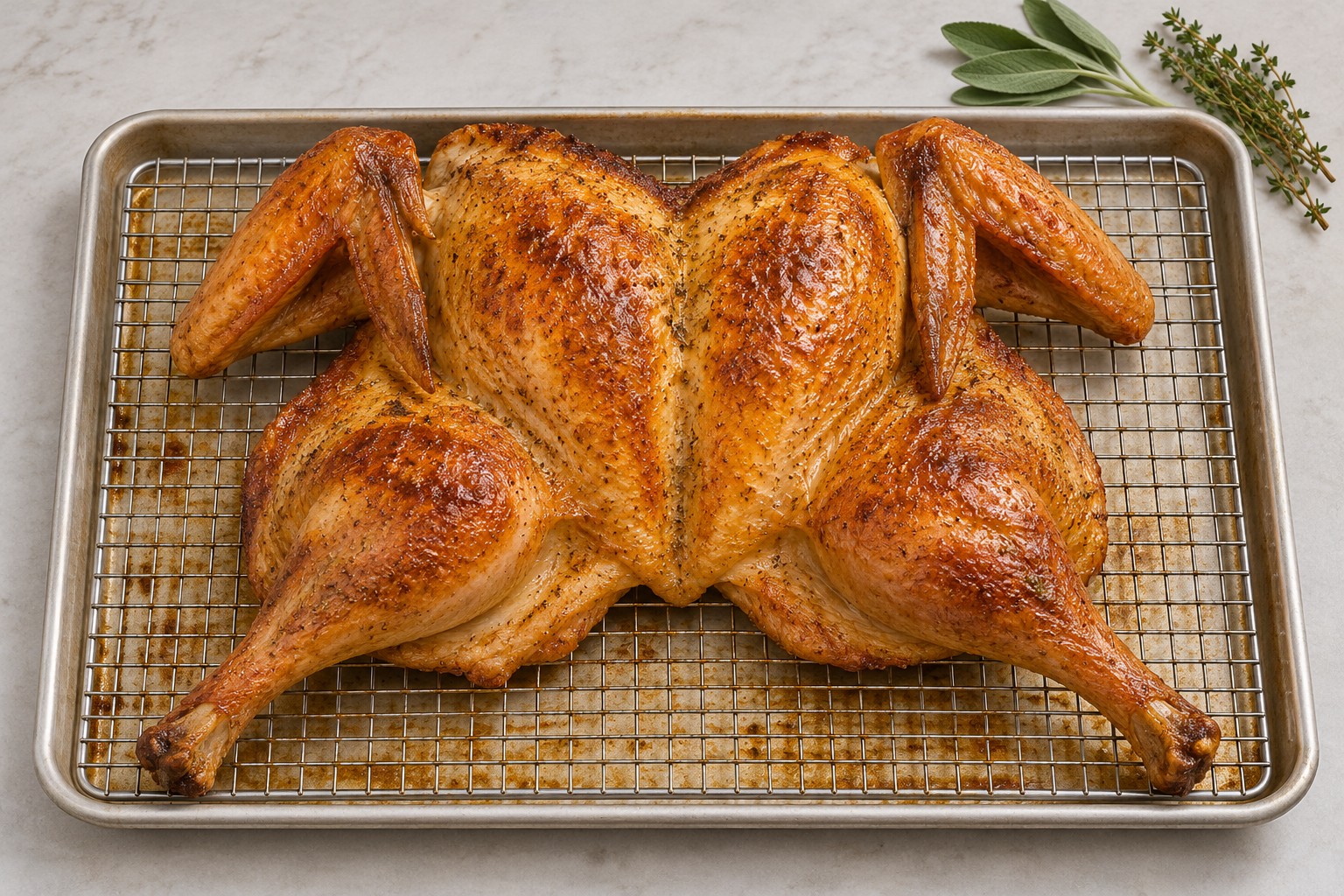
Spatchcocked turkey is flattened so more skin faces the heat and the bird roasts in a more even layer. Choose it when you value crisp skin and a shorter cook over the upright whole-bird presentation.
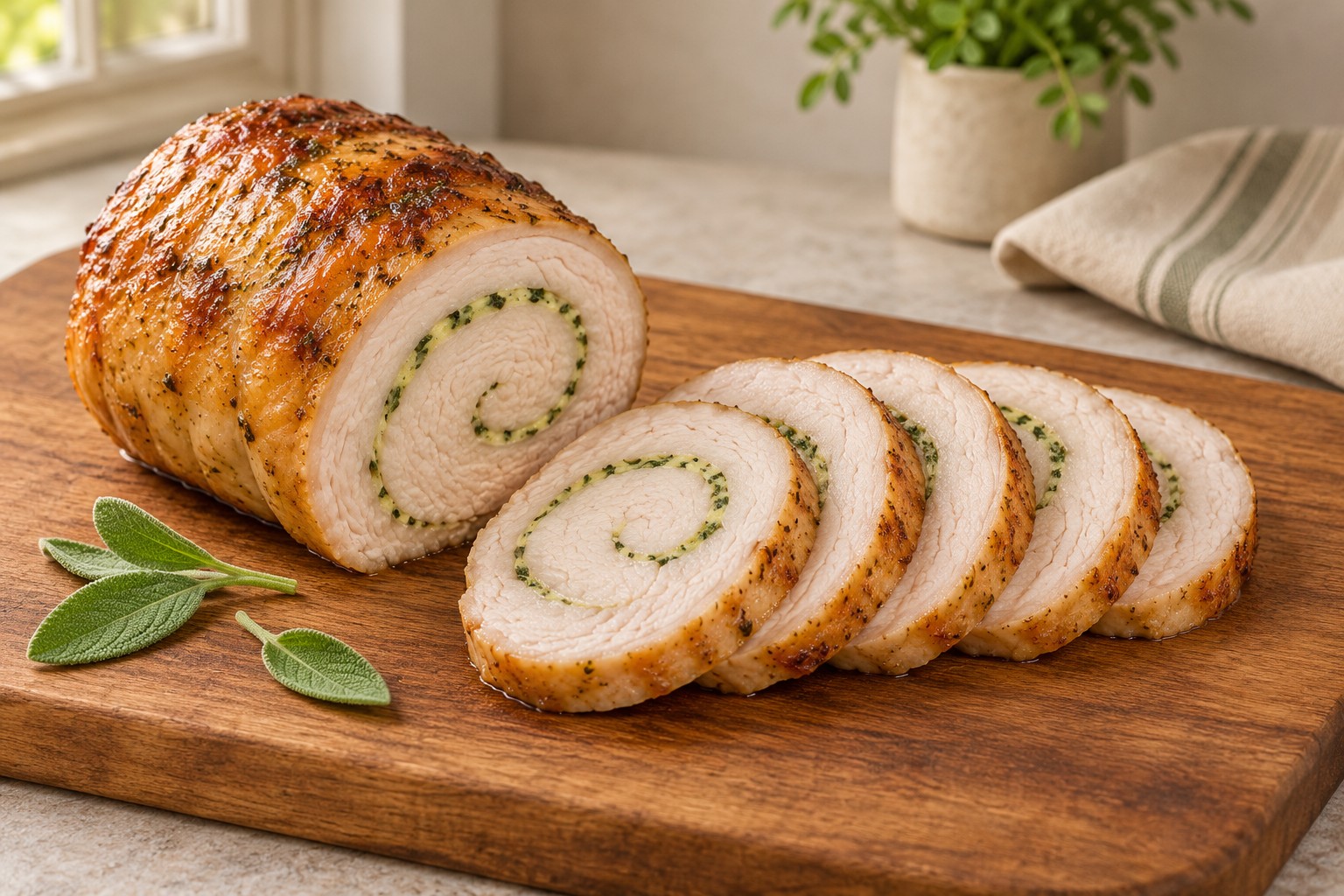
Herb-butter turkey roulade turns a boneless breast into a compact roast that slices into tidy spirals. It is a good option for a smaller table or a group that mostly wants white meat.
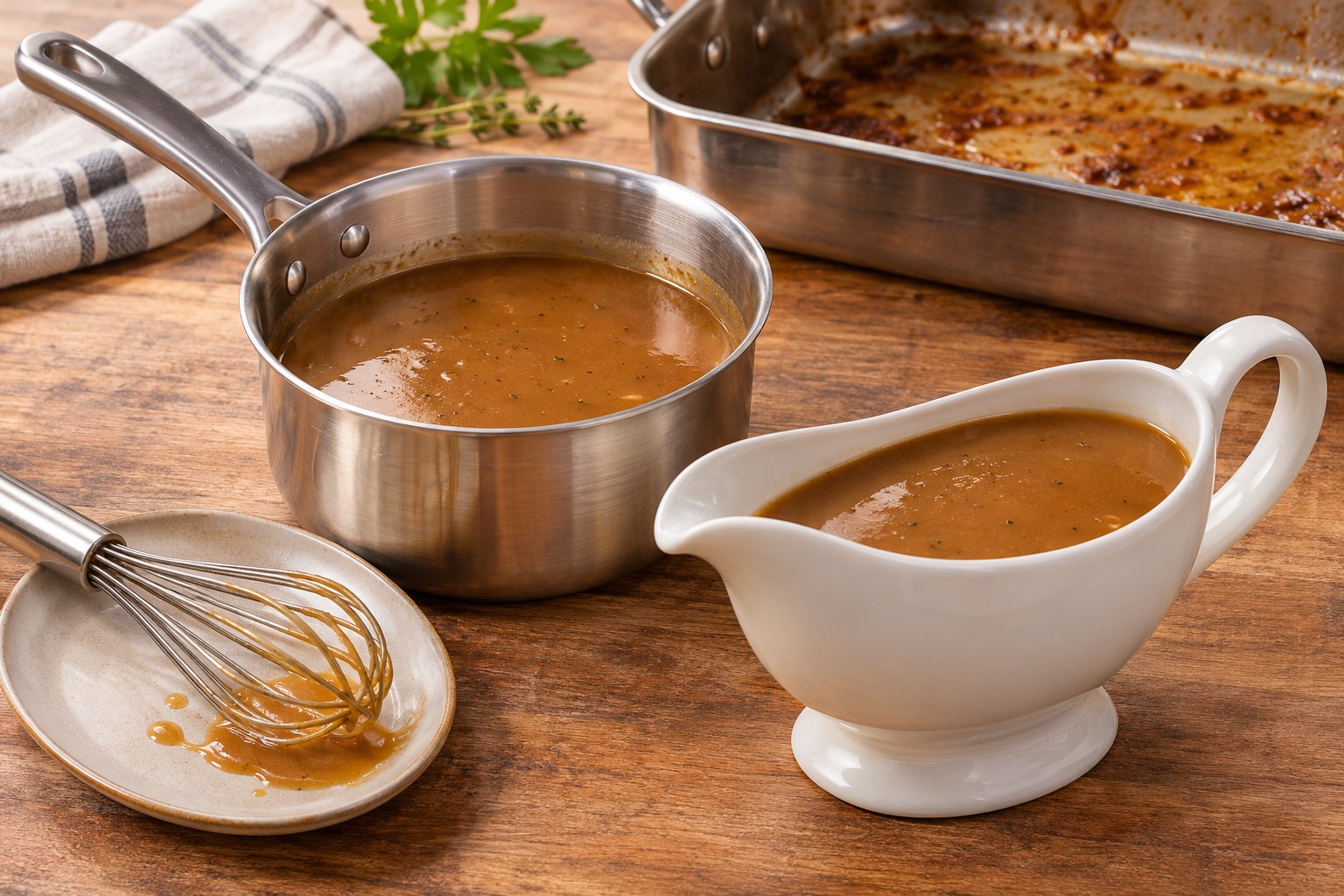
Gravy from the drippings brings the roasting pan's browned flavor into the meal. Make it during the resting interval, using unsalted stock and tasting before adding salt.
The reliable finish is the same whichever route you choose: meat cooked through, seasoning that suits the bird you bought, and enough time to bring everything to the table calmly.
More to explore
Food
Spatchcock Turkey: A Flatter Roast for Crisp Skin and Easier Timing
Flatten a fully thawed turkey, season it with herb butter and roast it on a wide rack. Temperature checks keep the shorter cooking time honest.
Food
Herb-Butter Turkey Roulade for a Smaller Thanksgiving Table
A boneless breast rolled with sage, parsley and lemon makes tidy slices and a manageable roast. Ask the butcher to do the boning and butterflying.
Food
Turkey Gravy from the Drippings: Smooth, Savory and Properly Seasoned
Separate the fat, loosen the browned bits and whisk a simple roux. Taste cooked drippings before adding salt—especially with a pre-brined bird.